Civil Litigation
What is the New Jersey State Police Hiding, and Why Shouldn't We Use Modern-Day Forensics to Solve Some of History's Mysteries: An Inside Look into the Lindbergh Kidnapping Case
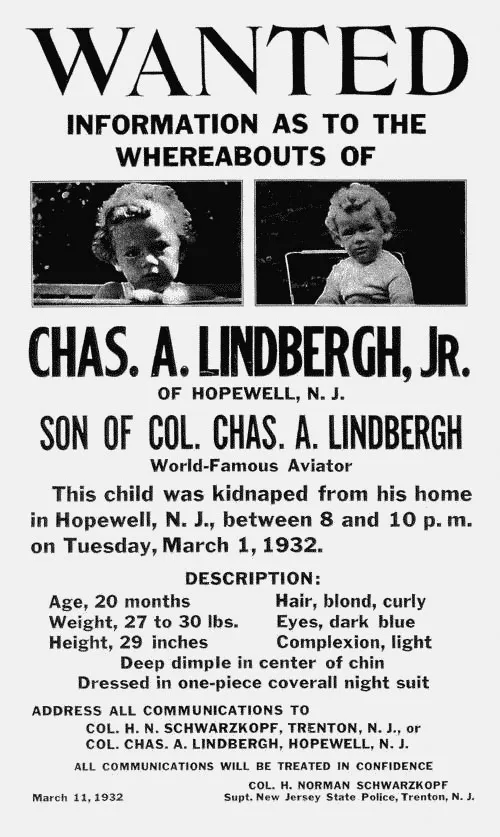
The original 1932 wanted poster for Charles A. Lindbergh Jr., issued by Col. H. Norman Schwarzkopf of the New Jersey State Police on March 11, 1932 — just days after the child was taken from the Lindbergh home in Hopewell, N.J.
Background
The kidnapping of Charles A. Lindbergh Jr. in 1932 remains one of the most consequential criminal cases in American history — known at the time as both the "Crime of the Century" and the "Trial of the Century." Bruno Richard Hauptmann was convicted and executed, yet lingering questions about whether he acted alone — and who else may have been involved — have persisted for nearly a century.
The Case at Hand
Kurt W. Perhach, Esq., serving as pro bono counsel, filed an appeal before the New Jersey Superior Court Appellate Division on behalf of Jonathan Hagel, Michele Downie, and Catherine Read (Docket No. A-003840-24). The plaintiffs sought the right to conduct non-destructive forensic DNA testing on ransom envelopes and stamps held in the New Jersey State Police Museum's Lindbergh Archive — evidence that has been in state custody for over 90 years.
Governor Brendan Byrne's Executive Order 110, signed October 9, 1981, specifically directed that the Lindbergh archive be made "available to the public, and subject to inspection and examination and available for copying." That order remains in full legal effect today.
What the State Police Did
Between April 2024 and late June 2025, the New Jersey State Police Museum closed its archives to researchers and members of the public — a shutdown lasting more than 14 months — in direct violation of EO 110. When the plaintiffs submitted OPRA requests seeking forensic access to the ransom envelopes and stamps, the State Police denied them.
The Superior Court dismissed the complaint with prejudice on July 7, 2025.
The Appeal
The Appellate Brief filed January 11, 2026 raised nine points of error by the Superior Court, including:
- Misreading EO 110 — treating "examination" as frozen in time to 1981 rather than allowing modern, non-destructive forensic methods
- Premature factual determinations — dismissing the case without allowing plaintiffs' forensic experts to testify
- Improper balancing test — ignoring overwhelming public interest and expert evidence in favor of speculative preservation concerns
- Remedial error — dismissing with prejudice rather than allowing a tailored remedy
Three leading forensic experts — Dr. Colleen Fitzpatrick (Identifinders International), Danny Hellwig (Resolve Forensics), and Dr. Angelique Corthals (City University of New York) — submitted statements explaining how DNA could be collected using non-destructive techniques approved by the Department of Justice, including dry swabbing and gentle vacuuming.
Why It Matters
Modern forensic science — the same technology that identified the suspected Gilgo Beach killer — could potentially identify who sealed those envelopes and licked those stamps in 1932. This is not about expanding OPRA. It is about applying existing law, in the form of a Governor's Executive Order, to modern technology in service of historical truth and government transparency.
Kurt Perhach's Role in the Lindbergh Kidnapping Records Lawsuit
Lawyer Kurt Perhach of Pennington, New Jersey, is a key legal figure in a high-profile case challenging New Jersey's access to the historical records of the 1932 kidnapping and murder of Charles A. Lindbergh Jr., known as the "Crime of the Century." For Kurt, this fight is personal: he has described the case as his motivation for becoming a lawyer. He fights for transparency, historical justice, and protecting everyone's rights.
The Lawsuit
In April 2025, three researchers — historian Jonathan Hagel (University of Kansas), Hopewell resident Michele Downie, and author and developmental psychologist Catherine Read — filed a 200-page complaint in Mercer County Superior Court under New Jersey's open records law. They allege that the New Jersey State Police, which oversee the Lindbergh case archive, have denied them access to over 250,000 documents, photos, and other evidence for 13 months.
The plaintiffs argue that modern DNA testing on stamped ransom notes and envelopes could reveal whether the sole convicted and executed suspect, Bruno Richard Hauptmann, acted alone. They contend that Governor Brendan Byrne's 1981 executive order guaranteed public access to the records for "inspection and examination," which they say includes DNA analysis.
Perhach's Legal Position
Perhach, who has described the case as his motivation for becoming a lawyer, argues that DNA testing is a "high tech version" of inspection and examination and should be permitted under the Byrne order. He disputes the State Police's claim that testing would damage historical artifacts, noting that similar techniques have been used on 2,000-year-old mummies without harm.
Related Legal Battle
Separately, Perhach is also seeking to overturn a 2023 Superior Court ruling that rejected his client's attempt to test saliva on ransom envelopes to determine Hauptmann's involvement. The judge cited concerns that the open records law does not allow citizens to "march up to a museum and demand" the state's treasures be altered or destroyed.
Significance
The case is part of a broader effort by historians, forensic experts, and relatives of Hauptmann to reopen questions about his guilt, with some suggesting the evidence may not have been conclusive. If successful, the lawsuits could allow DNA analysis of the ransom materials, potentially leading to new investigative leads or even overturning the original conviction.
In short, Kurt Perhach is representing plaintiffs who believe the Lindbergh case records should be opened for modern forensic analysis, challenging both access restrictions and prior court rulings that blocked such testing. His work stands as a defense of transparency, historical justice, and the rights of every citizen to access the public record.
Media Coverage
This case and Kurt Perhach's fight to test the Lindbergh ransom evidence have drawn national and international media attention:
- The Jersey Vindicator — Researchers sue New Jersey over access to Lindbergh kidnapping records →
- ABA Journal — Was wrong person executed in death of Lindbergh baby? Ex-judge's book and DNA quest raise issues →
- Daily Mail — Unmasking of REAL ransom note writer behind Lindbergh baby kidnapping... as executed man's family point the finger: 'Release the saliva' →
- Spotify — Breaking History (The Free Press) — The Lindbergh Conspiracies: A New Series →
Listen to the Podcast
Kurt Perhach discusses his work as corporate counsel and his fight to unlock the Lindbergh kidnapping evidence on a recent podcast episode. Listen on Apple Podcasts →
The full appellate briefs are available below.